
What happens when the other side has the answer you need?

Why teamwork works
All living systems, from molecules forming cells to tribes forming nations, are built and sustained through mutually beneficial cooperation. This deep biological truth aligns with decades of social scientific research highlighting the power of teamwork across lines of division.
What the research shows
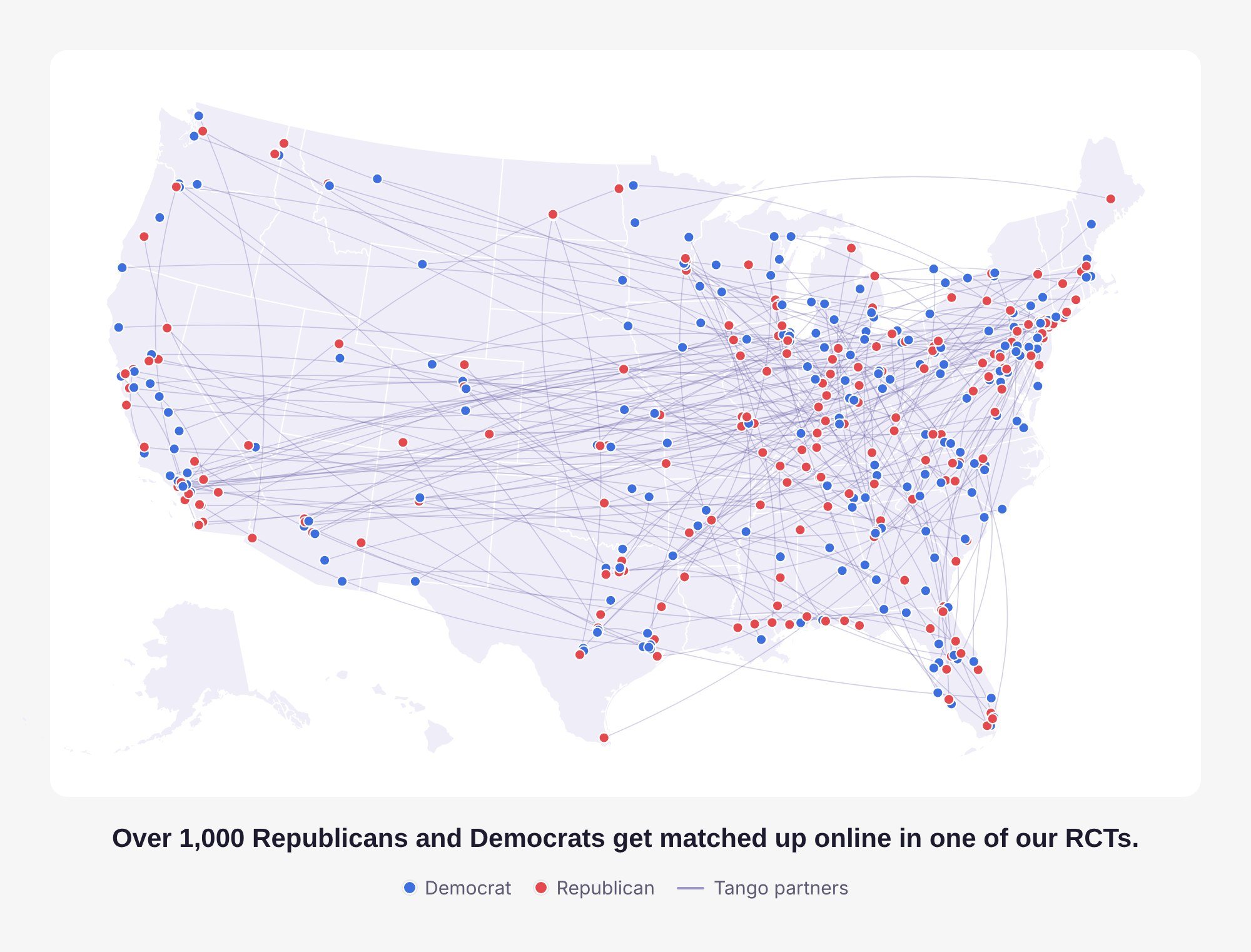
5 randomized experiments with 4,493 participants, balanced between Republicans and Democrats. Foundational research published in Nature Human Behaviour
Reduced animosity and increased generosity lasts four months after a single game
10/10: median enjoyment rating
New field experiments on three college campuses show increased openness to new ideas and people and comfort voicing controversial view.
Most students give contact information to meet their game partners in real life - and many do.

Dialogue needs respect first
When the topic is division, the usual answer is dialogue. Dialogue matters, but it depends on a basic level of respect that has worn away in the US and beyond. Many people now feel it's not just unpleasant but wrong to talk with someone who disagrees with them.
Most work on polarization is built around empathy. Our research points somewhere else.
Across randomized trials with thousands of participants, what moves the needle is mutual respect: discovering that someone you disagree with can be a capable, trustworthy partner.
Tango is designed to create exactly that experience, and it reaches people who would never sign up for a conversation about politics.
Respect before persuasion
Most bridging programs jump right into moral debate. Tango builds trust by starting with facts and teamwork.
Tango uses fun and thought-provoking questions, grounded in research, that challenge preconceptions on all sides.
A typical quiz starts with low-stakes pop culture (food, movies, music) before moving into political territory (guns, immigration, Middle East conflict).
Throughout, the goal is to agree on what's true, not to reconcile values. Everyone has something to contribute. Everyone has something to learn. The key psychological lever is mutual respect.
No side owns the truth.
Tango isn't pushing one point of view or claiming that the truth is always in the middle. But working through tough questions reveals that the world is complicated, that no side has a monopoly on truth, and that people can disagree and still work together toward shared goals. Every question is drawn from scholarly articles, nonpartisan polling, government statistics, nonprofit research and reputable journalism.
New Content Monthly
Cancel Anytime
New Content Monthly Cancel Anytime
Our Research
Our Foundational Research
Defusing political animosity in the United States with a cooperative online quiz game
Nature Human Behaviour, 2025 · Lucas Woodley, Evan DeFilippis, Shankar Ravi and Joshua D. Greene
Rising political animosity threatens democracy in the United States and other nations. Previous research indicates that intergroup contact under favourable conditions can reduce animosity. Other research indicates that mutually beneficial cooperation is essential for maintaining complex social structures. Building on these ideas, we asked whether mutually beneficial cooperation can reduce animosity between opposing political party members and whether this is possible in an anonymous online context. We created an online quiz game, Tango (letstango.org), where Republicans and Democrats partner and communicate in real time. Across five experiments (N = 4,493, four preregistered), we find that an hour of gameplay with an outparty partner can reduce negative partisanship, with increased self-reported warmth, more equitable economic allocations and more favourable outparty meta-perceptions persisting for up to four months. Gameplay also improves democracy-related attitudes, with effects persisting for one week. The game receives high enjoyability ratings, which may increase motivation to engage with this intervention.
Working paper: Field experiments in higher education

Combating ideological sectarianism on college campuses with a brief cooperative online quiz game
Lucas Woodley & Joshua D. Greene
Openness to differing viewpoints and the people who hold them is critical for higher education. And yet there is widespread concern in the U.S. and elsewhere about a lack of ideological diversity and openness on college campuses. Across six preregistered field experiments on three U.S. campuses, we show that a 15-minute cooperative online quiz game called Tango significantly increases students’ openness to differing ideas and people, reduces outgroup animosity, increases comfort expressing controversial views, and facilitates interpersonal connection. The game is also rated as highly enjoyable. These findings provide evidence that a brief, enjoyable, and scalable cooperative game can promote intellectual and ideological openness on college campuses.
See it for yourself
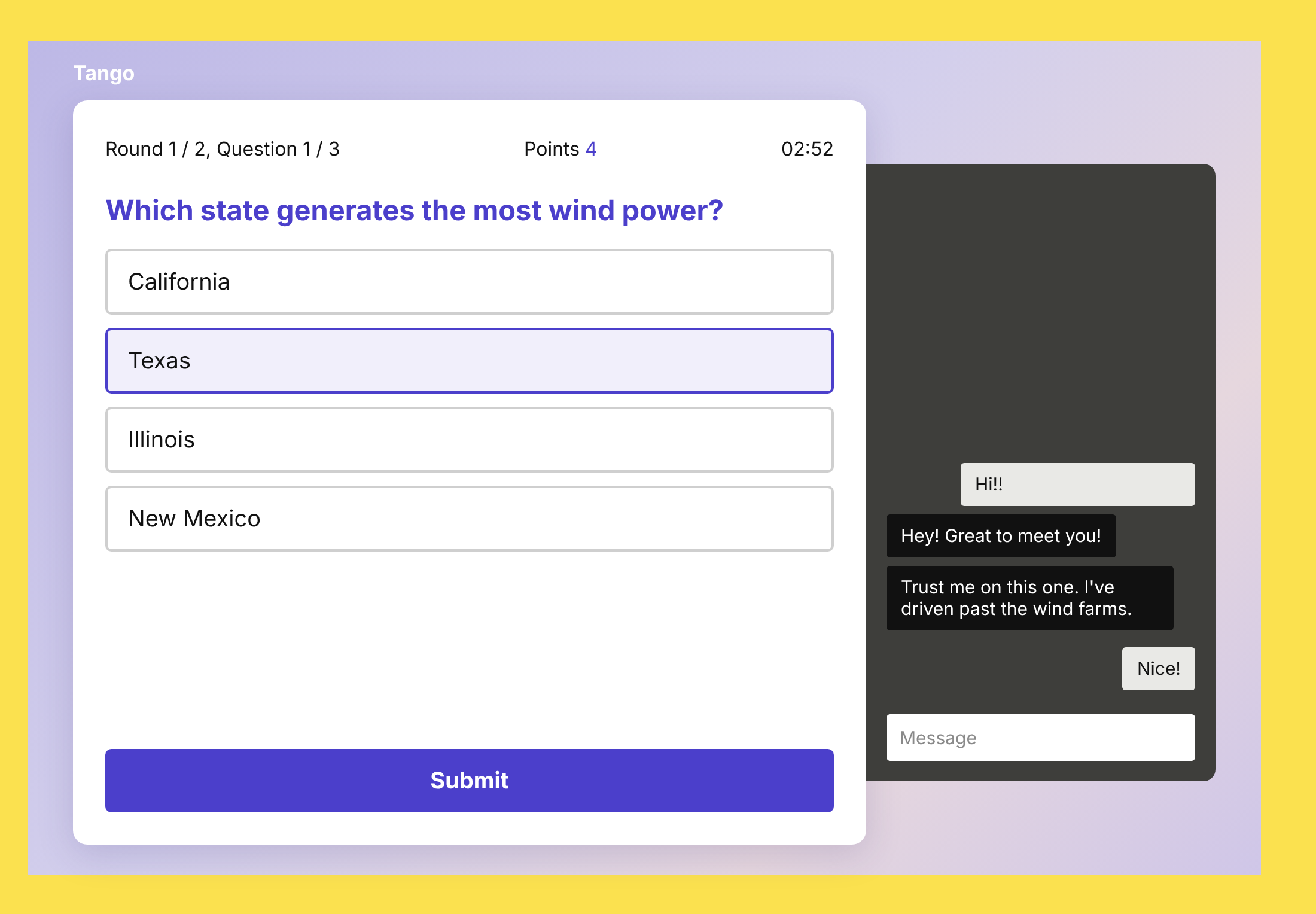
The best way to understand Tango is to play a round. Here's how it starts:
Three short steps
Talk. A short call about your group and who you want to reach.
Play. Try a round with your team, so you know exactly what your people will experience.
Launch. We customize the game content and handle the technology and data.